
Presentation

With the digitalisation of transport services, train localisation in real time has become increasingly important for the European railway sector. At present, determination of the position of the train for signalling purposes is based on trackside equipment such as track circuits or axle counters, which are physical elements mounted at specific intervals along the railway track.

The signalling systems on-board the train also use the train odometry to control the speed and carry out the movement authority of the train by estimating the braking curve to protect dangerous points on the network (e.g. closed block, curves, speed limit, etc..).

GNSS could prove a game changer for the European railway network by enabling a significant reduction of trackside equipment and by improving localisation performance. However, fusion with other sensors will be necessary to mitigate the known impact of local effects on GNSS performance.

Capitalising on the achievements of EC and GSA funded projects, key European railway companies have decided to team together and collaborate through the CLUG project for the proof of concept of a “Certifiable Localisation Unit in the railway environment”.

The CLUG project will perform a mission analysis/needs identification and a preliminary feasibility study of an on-board localisation unit with the following characteristics: 

  • Failsafe on-board multi-sensor localisation unit consisting of a navigation core (IMU, tachometer, etc.) brought in reference using GNSS, track map and a minimal number of reference points;
  • On-board continuous localisation system that provides location, speed and other dynamics of the train;
  • Operational and interoperable across the entire European rail network;
  • Compatible with the current ERTMS TSI or with its future evolutions.

Main objectives of the project

Visuel
Mission requirements and definition.

A “top down” approach establishes needs, objectives, and top-level functional and performance requirements of the train localization unit

Visuel
Architecture definition and algorithm prototype development

Identification system concepts that meet the requirements that have previously been defined + analysis of the current and future EGNSS

Visuel
Development of process and tools for certification of localisation unit

Initial development of tools and processes for the qualification and certification of a train localisation unit 

Visuel
Demonstration of the feasibility of a multi-sensor approach

Test prototyped architecture and algorithms in various modes to determine whether requirements are supported using real world data

Overall structure of the workplan

The project has been structured around 5 work packages as shown in the table below
WP1
Project Mangement and Coordination

to ensure the coordination between consortium members and across activities; to manage the administrative issues of the project 

WP2
Mission Definition and System Requirements

to define the system needs, the operational scenarios and the high-level system requirements

WP3
Localisation System Design

 to elaborate a Localisation System design following a system engineering 

WP4
Testing and evaluation

to test and evaluate the performance of localisation solutions consisting of different receivers and sensors, combined by fusion algorithms, using real world data 

WP5
Application to the train Localisation System

to exploit, summarise, disseminate and communicate the project outcomes 
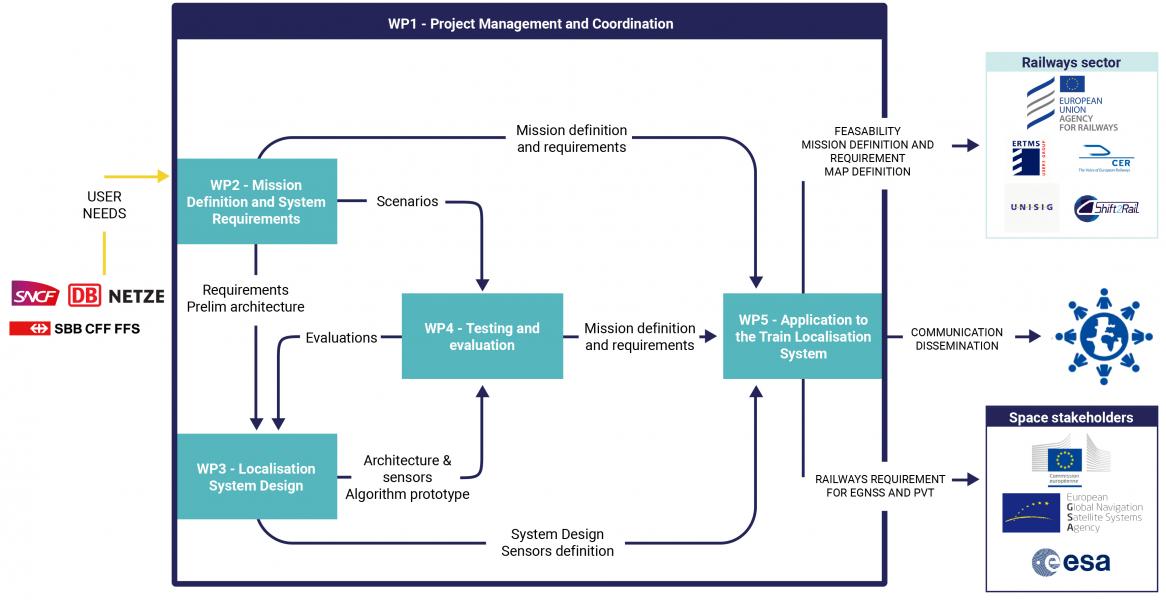
Workplan-schema

The differents steps of the project

December
2019

Project kick off

July
2020

Test plan definition ready

Beginning of the measurement campaigns

November
2020

Preliminary mission and requirement definition

June
2021

Test plan definition ready

Beginning of the measurement campaigns

November
2021

Algorithm design

EGNSS requirements

December
2021

Partners

GSA

GSA

Space is the new technological revolution and it is changing the way we live, work  and play. GSA’s core mission is to ensure that European Citizens get the most out of Europe’s satellite navigation programmes. The GSA’s mission is to support European Union objectives and achieve the highest return on European GNSS investment, in terms of benefits to users and economic growth and competitiveness

> see website > Return to partners
DB

DB

"Deutsche Bahn AG (DB) is the leading mobility and logistics service provider in Germany. Over the past few years, the DB Group has developed, step by step, into a leading international mobility and logistics service provider.
The Group provides services in three major divisions:
• ensures mobility for its customers in long-distance, regional, urban, and freight transport,
• provides logistics services worldwide, and
• operates the track infrastructure and offers transport- related services
DB Netz AG is the railway infrastructure manager of Deutsche Bahn AG.It is responsible for the approximately 33,300 kilometre long rail network, including all operationally necessary installations. An average of 40,000 trains are using DB Netz AG’s infrastructure per day."
 

> see website > Return to partners
SBB CFF FFS

SBB CFF FFS

Swiss Federal Railways (SBB) is Switzerland’s national train company and largest transport company. The Swiss are European champions in rail travel: In 2017, the satisfied demand was at 19 bn passenger kilometers, that means each Swiss covered approx. 2300 km by rail. The SBB Group is made up of the five divisions Passenger, Freight (SBB Cargo), Infrastructure, Real Estate and IT.
 

> see website > Return to partners
SNCF

SNCF

SNCF missions? To simplify your journeys, to make the transport of people and goods more fluid and to develop the mobility of tomorrow. To meet these challenges, SNCF is organised around a parent company and SNCF Réseau, SNCF Gares & Connexions, Rail Logistics Europe, SNCF Voyageurs, Geodis and Keolis.

> see website > Return to partners
CAF

CAF

CAF is a multinational group with over 100 years of experience in the supply of comprehensive transit solutions positioned at the forefront of technology for high value added sustainable mobility. The company is a leader of the railway industry offering one of the most comprehensive and flexible arrays of products in railway related markets, such as rolling stock, components, infrastructure, signalling and services (maintenance, refurbishing and financial services).
 

> see website > Return to partners
Airbus Defense & Space

Airbus Defense & Space

"Airbus Defence and Space is one of the three Divisions of the Airbus Group and Europe’s Number 1 defence
and space company. Comprised of three business lines – Military Aircraft, Space Systems and Communication, Intelligence and Security (CIS) – Airbus brings together a wide portfolio to meet the complex needs of its customers, contribute to nations’ defence and security, and secure Europe’s sovereign and independent access to and utilisation of space."
 

> see website > Return to partners
ENAC

ENAC

"L’Ecole Nationale de l’Aviation Civile (ENAC) or French Civil Aviation University is a public institution under the supervision of the French Ministry of transport. Its mission is to provide ab-initio and further training for the executives and main players of the civil aviation world and do research in a variety of air transport related domains. ENAC Research Lab is organised in academic teams of research: Optimisation and Machine learning, Data Economics and Visualization, Telecom, Interactive Computing, a set of transversal
programs to monitor applied research: Safety and security, Sustainable development and Drones and two platforms Aeronautical Computer Human Interaction Lab (ACHIL) and the UAS Flying Arena."
 

> see website > Return to partners
NAVENTIK

NAVENTIK

The mission of NAVENTIK: Enabling Satellite Navigation for Automated driving. Established in 2017 as a Startup company from Chemnitz University of Technology, NAVENTIK is providing GNSS solutions for safety-critical applications. The NAVENTIK founding team is composed of tech enthusiasts and disruptive business experts.

> see website > Return to partners
NavCert

NavCert

> see website > Return to partners
FDC

FDC

FDC is an independent consultancy and engineering company specialised in the field of Space applications and security, based in Vincennes, France. Through the support provided to the European Commission and its Agencies since the very early stages of the two flagship Space programmes of the European Union, FDC has acquired a recognised knowledge of both Copernicus and the European GNSS programmes Galileo and EGNOS. Over the last three decades, FDC has been strongly involved in about 150 EC support and R&D projects related
to GNSS, and has successfully coordinated more than half of them.

> see website > Return to partners
SIEMENS

SIEMENS

"Siemens Mobility GmbH (headquartered in Berlin) is the 100% owned mobility branch of Siemens AG, a global powerhouse in electronics and electrical engineering, operating in the industry, energy and healthcare
sectors.
Since pioneering electric traction for railways in the 19th century, Siemens Mobility has been a leader in transport solutions for more than 160 years.
Siemens Mobility is constantly innovating its portfolio in its core areas of rolling stock, rail automation, electrification, turnkey systems, intelligent traffic systems as well as related services for both mainline and mass-transit railways."
 

> see website > Return to partners